DVNET-3000 · IP network load message-on-hold system
This audio playback system can be controlled from any home or office. Delivers audio messages to one or more location via internet
The DVNET-3000 is a versatile Message-On-Hold System that combines high quality audio playback for use even in the most demanding applications. The system supports a single, or multiple audio messages which are played sequentially.
Overview
Key features
- Removable SD card, non-volatile memory that supports card storage up to 2 GB
- Connects to the network over a standard Ethernet interface
- Supports standard MP3 files
- Adjustable, dual audio output (8 Ω / 600 Ω)
- Adjustable tone control
- 15 kHz audio bandwidth
- Message downloads through the CMAC software interface
- Audio message lengths completely dynamic
- Integrated monitor speaker
- Industrial grade all metal construction
- 3-position flexible mounting scheme
- Backed by a 3 year warranty
- Connects automatically to the provider’s CMAC system on any Ethernet network with an Internet connection; message updates and system control need no user intervention
- CMAC software: Windows 98, XP and Vista compatibility
- CMAC software: maintains a database of contacts and groups
- CMAC software: flexible download settings for network or telephone / fax line applications (with the DVTEL-3000 telephone download system)
- CMAC software: generates reports
Specifications
| Audio | |
|---|---|
| File formats | MP3 |
| Bandwidth | 15 kHz |
| Output | Adjustable dual output, 8 Ω / 600 Ω |
| Monitor | Integrated speaker |
| Signal to noise | 80 dB |
| Messages and storage | |
| Messages | One or several, played in sequence |
| Loading | IP network, to one or more locations |
| Memory | Removable SD card, up to 2 GB; ships with 1 GB or more |
| Control | |
| Manual controls | Output volume, tone, speaker enable |
| Indicators | Memory, Transfer, Status, Connected, Playing LEDs |
| Physical | |
| Dimensions | 6.4″ W × 4.6″ D × 1.1″ H |
| Power | 12 VDC, 1 A; power pack included |
| Mounting | Painted steel chassis; 3-position mounting (flat, side or horizontal) on wall or board, or table top |
| Warranty | 3 years |
| Interfaces | |
| Network | Ethernet, RJ45; DHCP by default; other settings (proxy, gateway) with Mackenzie NSU software; primary and secondary provider servers |
User manual in brief
Overview
The DVNET-3000 is a highly reliable audio playback system designed specifically for Message-On-Hold. It plays music and marketing messages while callers wait on hold or customers shop in your retail location, which heightens awareness, minimizes frustration and increases sales.
It plays one or several audio messages in sequence. The messages are MP3 files compiled by the provider and loaded into the unit over the Internet with the provider’s CMAC / CQueue software; they are kept in non-volatile memory that is not lost in a power outage. Line and speaker outputs with level control and tone adjustment let the sound be optimized for almost any telephone or PA system.
- In the box: DVNET-3000 with 1 GB of memory or more, power pack, 6′ RJ45 to RJ45 cable, audio cable, mounting hardware and user’s manual.
- Optional: MUSB-1GB (1 GB USB memory key).
Installation
Before installing, make sure you have a message-on-hold or music-on-hold input on the telephone system (or a line level input on the public address system) and a non-switched 120 VAC outlet near the unit.
- Mounting: the unit mounts on the telephone equipment board or a wall in one of three positions: flat, side or horizontal. Mark the mounting holes and fasten it with the screws provided; for table-top use, stick the enclosed rubber feet on the bottom.
- Power: plug the power pack into an outlet that is not controlled by a switch, then into the jack marked 12VDC. There is no power switch; the system is active as soon as power is connected.
- Telephone system: connect the supplied RCA to RCA cable from LINE OUT to the telephone system’s line level (M-O-H) input. Start with LINE OUT and set the level with the output level knob; if it cannot reach a high enough level, use SPKR OUT instead.
Network connection and configuration
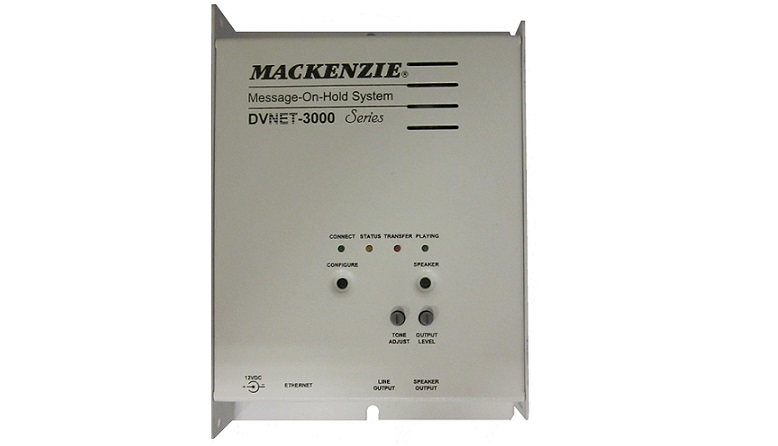
The DVNET needs Internet access to download new messages. With the supplied RJ45 cable, connect its Ethernet port to a hub or switch on the premises LAN that can reach the Internet. The Transfer LED blinks until the unit reaches the provider’s server, then the Connected LED lights solid. Check that the yellow Status LED is off; if it is lit, press the Configure button to turn it off.
- DHCP: the unit ships with DHCP enabled. On a network with a DHCP server it only needs to be plugged in, and it connects to the provider’s server by itself.
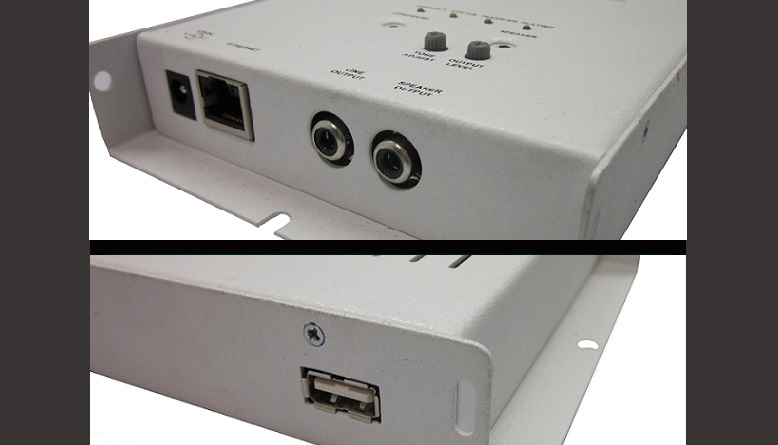
- Other networks: if the network does not use DHCP or has advanced settings such as a proxy server or special gateway addresses, a technician sets them with the Mackenzie NSU software, which creates a configuration file that is loaded into the unit from a USB memory key through its USB port.
- If the network settings change later, tell the provider; a new configuration file may need to be loaded.
Connections
- 12VDC (2.5 mm barrel): powered by the supplied 12 VDC, 1 A adapter; use only the adapter supplied by the manufacturer.
- ETHERNET (RJ45): standard interface to the LAN with Internet access; connect it to an open port on the hub or switch.
- LINE OUT (RCA, mono): 600 Ω line output, the standard level for most applications. Connect it to the telephone or PA system first.
- SPKR OUT (RCA, mono): amplified output, 2.5 W into 8 Ω, for an on-hold circuit or PA amplifier that the line output cannot drive to a high enough level.
Message loading and playback
The unit arrives with a sample message in memory. Once it is connected to the Internet and to the provider’s server, the provider downloads new material into it; nothing is loaded on site.
New messages start playing automatically after the download, and after every power-up playback starts without any control or user input. The unit plays message 1 through the last message in memory, then loops back to message 1.
Controls and indicators
- Output level knob: sets the level of both audio outputs; clockwise raises it.
- Tone adjust knob: clockwise lowers the bass and adds treble, counter-clockwise lowers the treble and adds bass; at the center no bass or treble is added.
- Speaker pushbutton: turns the internal monitor speaker on or off, to preview playback. The speaker is off by default, and its volume is fixed at the factory.
- Configure pushbutton: selects connection to the primary or the secondary server by hand. It is not normally used, only for troubleshooting.
- Memory LED (green): solid when the memory holds at least one valid audio message; blinks quickly twice every half second when it holds none.
- Transfer LED (red): lit whenever the unit communicates with the Internet, and for long periods while the provider downloads files. At power-up it blinks until the unit reaches the provider, then goes out.
- Status LED (yellow): normally off; it lights when the unit cannot reach the primary provider server and has connected to the secondary server.
- Connected LED: lit while the unit is connected to the provider’s primary or secondary server; when it is off, the Transfer LED blinks as the unit tries to connect.
- Playing LED (green): lit while messages are playing.
Power failure and troubleshooting
The memory needs neither power nor battery backup to keep its contents, so brownouts and power losses do no harm; when power returns, the system resumes what it was doing.
- No LEDs lit → check that the power adapter is in a non-switched outlet and fully plugged into the unit.
- Playing LED stays off → check with the provider that messages have been downloaded to the unit.
- No sound from the output → check the RCA cable at both ends, turn the output level clockwise, or use the 8 Ω output instead of the line output.
- No sound from the monitor speaker → if the Playing LED is off, there are no messages; press the Speaker button to toggle the speaker; check with the provider that the message level is adequate.
- Too much bass on hold → turn the tone adjust clockwise, or ask the provider to equalize the messages to reduce the bass.
- Too much treble on hold → turn the tone adjust counter-clockwise, or ask the provider to equalize the messages to reduce the treble.
- New messages do not download → check the network cable in the ETHERNET port, that the Connected LED is lit and the Status LED is off; then ask the provider for a real-time download. The Transfer LED should blink during it; if it does not, have the provider check that the unit’s serial number matches their records.
- Connected LED never lights → check the network cable, that the LAN port has Internet access (try a web browser on a computer on the same LAN), and tell the provider about any change in the network settings; a new configuration file may be needed.
Documents
| Document | Content | Format |
|---|---|---|
| Spec sheet | Specifications | |
| Operation guide | User manual, version 1.1 | |
| Quikey: connectivity detail | Connectivity detail |
Images
Related models: Message on hold and storecasting
| DVSD-3000 | SD card / USB load message-on-hold system | |
|---|---|---|
| DVSD-3000MTS/LR | USB autoload storecaster with music-thru and local record | |
| DVTEL-3000 | Telephone load message-on-hold and storecasting system | |
| DVNET-3000 | IP network load message-on-hold system | This page |